
Reid’s Dome Project
Reid’s Dome Project
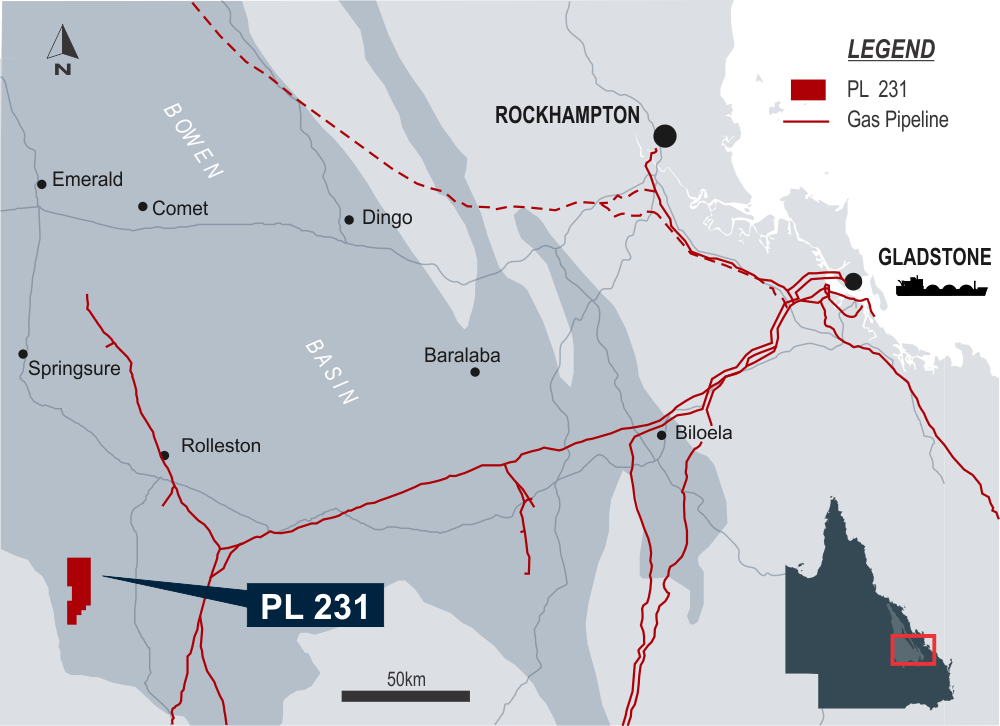
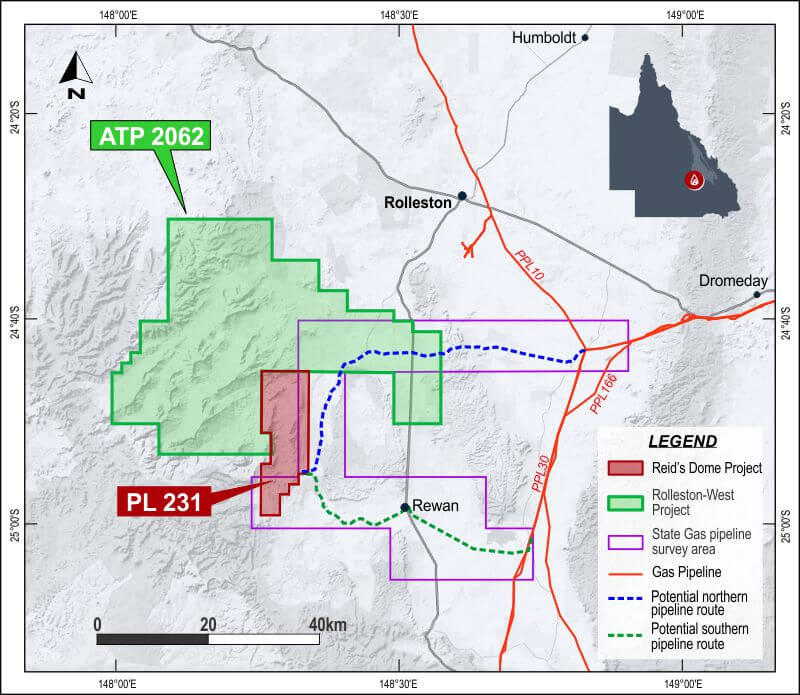
The Reid’s Dome Gas Project is contained within Production Lease 231, located approximately 50 kilometres south-west of Rolleston in Central Queensland, and 50 kilometres west of the Queensland Gas Pipeline. Reid’s Dome is within the Denison Trough, a sub-basin of the Bowen Basin, on the apex of the Springsure-Serocold Anticline.
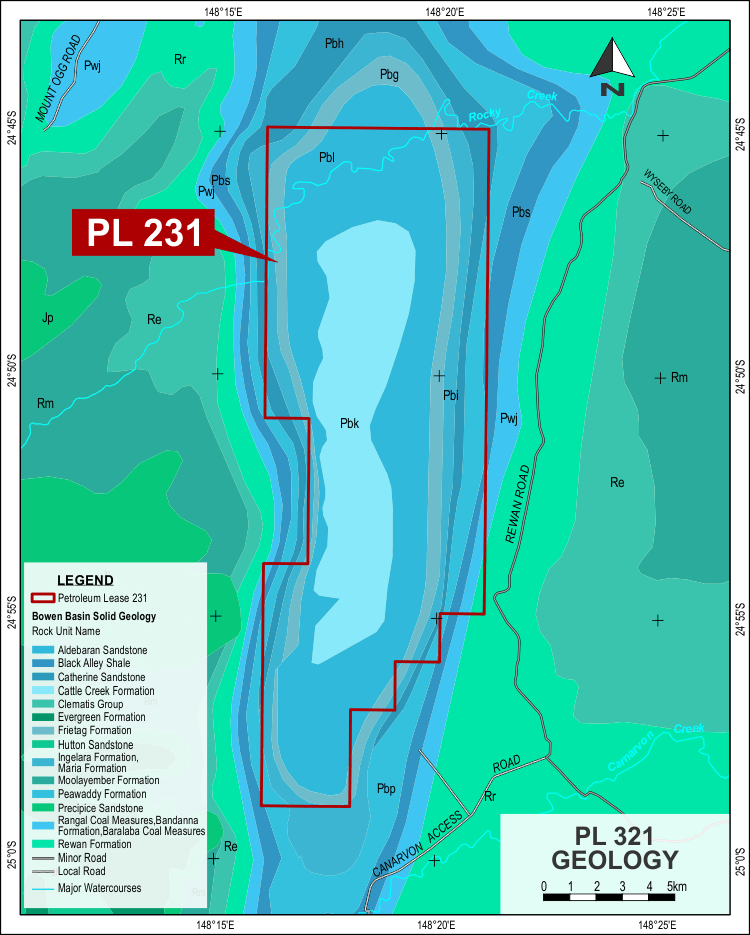
Geological structure of the Reid’s Dome at PL 231
Conventional gas
Conventional gas was discovered at Reid’s Dome during oil drilling in 1955, producing gas from gas sands in two zones, the shallow Cattle Creek Formation, a marine sandstone source rock, and the underlying Reid’s Dome Beds. Since that original discovery, a number of historical wells have flowed gas from the Cattle Creek Formation in the northern area of the permit, from depths of as shallow as 130 metres.
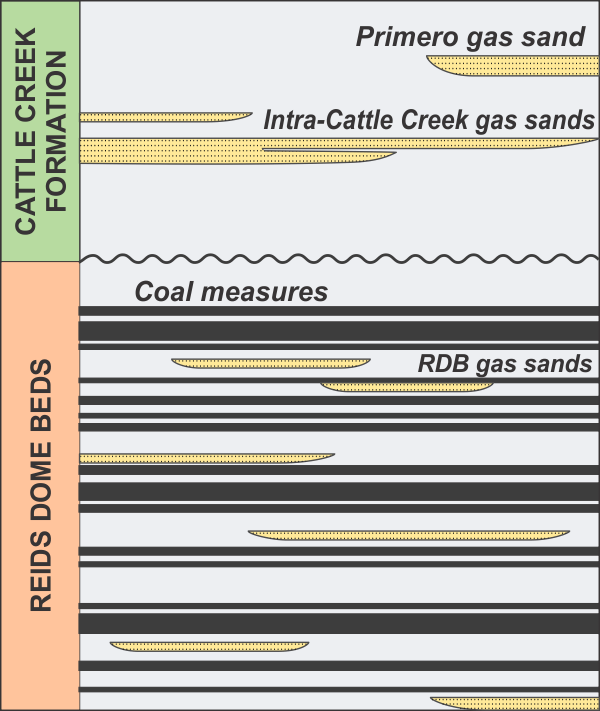
Indicative diagram of PL 231 Formations
Coal seam gas
In addition to conventional gas sands, the Reid’s Dome Beds contain extensive Permian coal measures throughout the permit. However, prior to State Gas, the area had not been explored for coal seam gas.
In late 2018 State Gas established the potential for PL 231 to contain a significant coal seam gas project with the drilling of the Nyanda-4 corehole.
In late 2019 the Company commenced a production test of Nyanda-4. In signs which are extremely positive for the commerciality of the Project, sustained gas production commenced after only five days of dewatering, with water production at the lowest end of the range for coal seam gas. Gas flows have consistently increased as the water level (and hence downhole pressure) has lowered. Both the gas flow and low water make are highly encouraging indicators for a commercial project.
State Gas’ activities have established in excess of 30 m of net coals in the producible zones in the beds (proven to extend below 1100m), with gas contents averaging a very high 13.75m³/tonne dry ash free. Commercial levels of production have been established at the Nyanda-4 well, with stabilised rates of 140mscf/d, punctuated by peaks of up to 700mscf/d. The Company continues to evaluate a range of techniques to successfully liberate gas from the deeper formations. Wells drilled during the 2019-20 and 2020-21 financial years confirmed the continuity of the Reid’s Dome coal seams across the majority of the permit, as well as discovering additional conventional gas in the northern area of the tenement.
Nyanda-4 gas flare – 9 January, 2020
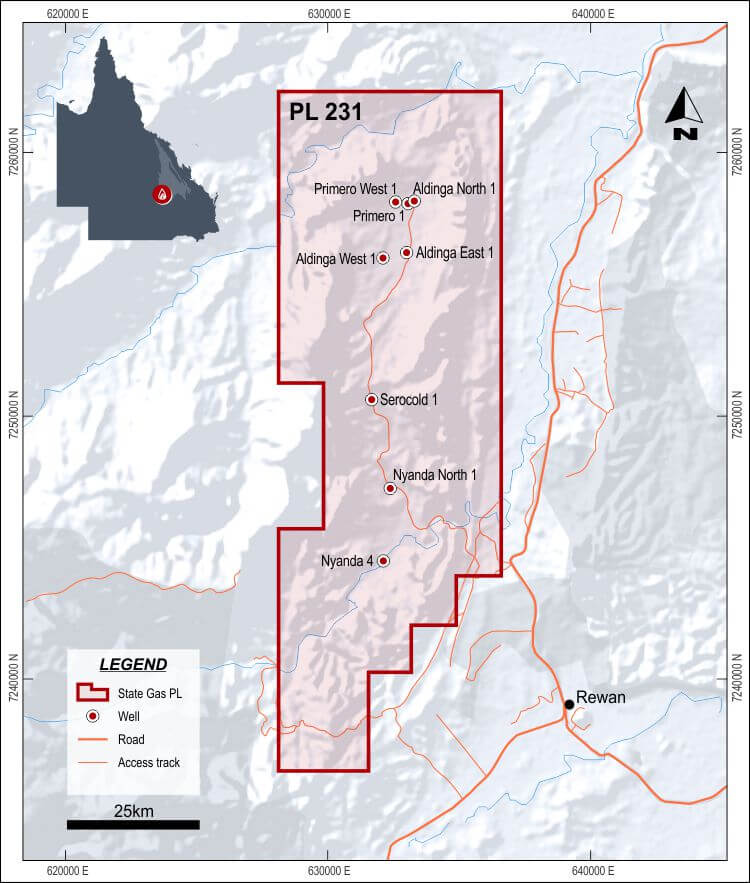
The results of the field activities have been very encouraging. Drilling in the northern and central areas of the permit has confirmed the presence of the Reid’s Dome coal measures throughout the spine of PL 231 with gas content on a par with Nyanda-4.
In order to investigate the potential of coal seams across the permit State Gas drilled the Aldinga East-1A well (approximately 12km to the north of Nyanda-4), and the Serocold-1 well (approximately half way between). Both Aldinga East-1A and Serocold-1 confirmed the presence of coal measures, similar to those at Nyanda-4, in the northern and central domains of the permit. Both wells contain a significant number of seams showing permeability.
The Serocold-1 production test commenced in January 2020 and quickly (within the first week) provided indications of gas production commencing.
In a surprise development likely to benefit the commerciality of the field, the Aldinga East-1A well discovered a new conventional gas pool located in approximately 9m of gas sand in the Cattle Creek Formation. A gas sample taken from the well indicated it was pipeline quality gas. In addition to the conventional gas, the Aldinga East-1A well intersected 14.6 metres of net coal.
The Company has identified pockets of conventional gas at Reid’s Dome that are capable of immediate, low cost extraction, subject to delivery of supporting infrastructure. State Gas continues to evaluate compressing and trucking this gas to existing pipeline infrastructure or directly to end users, using the same virtual pipeline approach developed for HDNG.
Deeper tight gas and condensate potential
PL 231 and ATP 2062 lie within the Denison Trough, which is geologically adjacent to the Taroom Trough and shares the same Permian source rock system. During 2026 State Gas re-evaluated historical sub-surface analysis within PL 231 to assess the viability of deeper oil and gas targets.
Previous wells drilled within PL 231, by State Gas and others, recovered sandstone core samples showing live gas and condensate, being direct physical evidence of a charged hydrocarbon system, with the reservoir demonstrating an overpressured environment, confirming that the system is actively charged and sealed. The prospective area covers up to 96 square kilometres within a four-way dip-closed anticline, a structurally favourable geometry.

About Us
Company profile, strategy and future growth


Investors
Investor information, reports and announcements

Shareholder Communication
Important information for shareholders

Sustainability
Workplace health & safety, environment and community
